horsetail-astral microtubule array
An array of astral microtubules that emanates from the spindle pole body during meiosis and facilitates horsetail nuclear movement. [GO:0032117]
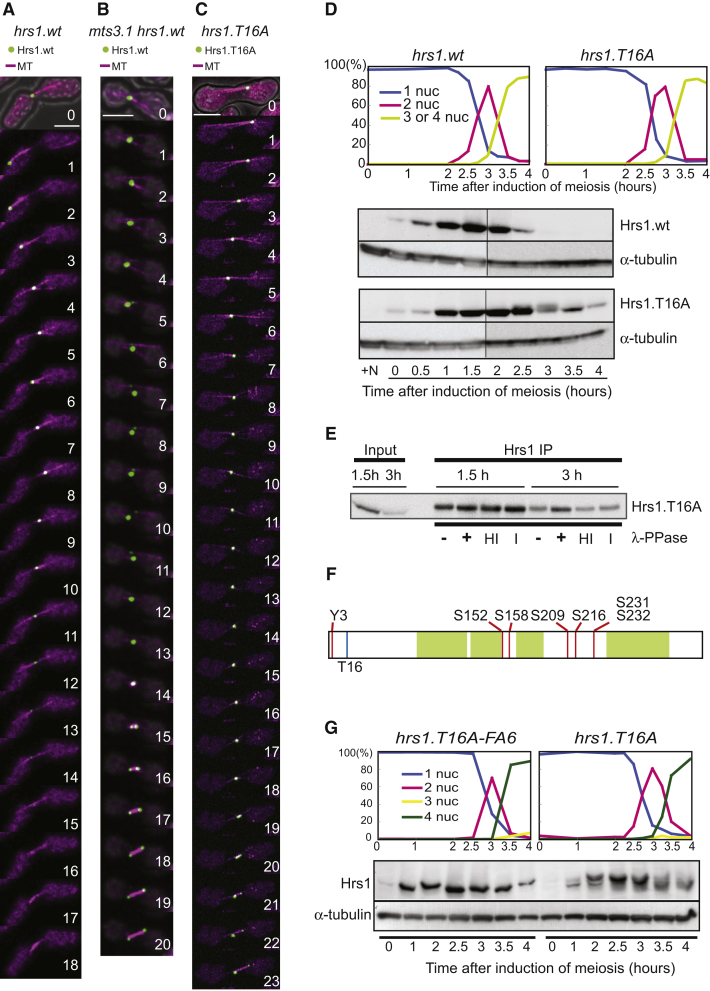
NCBITaxon:4896) · Charlotta Funaya, Shivanthi Samarasinghe, Sabine Pruggnaller, Midori Ohta, Yvonne Connolly, Jan Müller, Hiroshi Murakami, Agnes Grallert, Masayuki Yamamoto, Duncan Smith, et al.; CC BY, via PubMed Central · CC_BY_3_0 · source: PMC PMC3382715.1 fig4 · DOI:10.1016/j.cub.2012.02.042Synonyms: HAA
Part of: GO:0030981 — cortical microtubule cytoskeleton (no local record)
Components
| Component | Type | Part of / acts on | Grounding | Genes | Stoichiometry | Essential | Role |
|---|---|---|---|---|---|---|---|
| Alpha tubulin | Protein | part of | InterPro:IPR002452 | tub1, atb2, alp2 | UNKNOWN | Alpha-tubulin class of the microtubule polymer forming the meiotic radial array.
| |
| Beta tubulin | Protein | part of | InterPro:IPR002453 | UNKNOWN | Beta-tubulin class paired with alpha tubulin in the array microtubule polymer.
|
Organism-specific protein examples
Named proteins in which each component's role was established, with the organism the evidence comes from. The component above is the taxon-agnostic family; these are the specific entries behind it.
Alpha tubulin
| Accession | Protein | Gene | Organism | Entry |
|---|---|---|---|---|
UniProtKB:P04689 | Tubulin alpha-2 chain | tub1 | Schizosaccharomyces pombe 972h- (NCBITaxon:284812) | REVIEWED |
Role and evidence (2 references)Reference-sequence exemplar for species-level Atb2 imaging; the exact reference stock is not asserted to be the experimental strain.
| ||||
Canonical examples
NCBITaxon:4896Schizosaccharomyces pombe — Meiotic-prophase arrays studied in homothallic cells, including endogenously tagged Hrs1 and mCherry-Atb2 strain KT2901 for Figure 4A, and separately in synchronized pat1 mat-Pc diploids for ultrastructure. No fungal-wide prevalence or identity with the UniProt reference stock is asserted. [DOI:10.1016/j.cub.2012.02.042]
Functions
- dynein-driven meiotic oscillatory nuclear movement
GO:0030989— Provides the radial microtubule array that leads spindle-pole and nuclear oscillations during S. pombe meiotic prophase, acting with dynein-dynactin machinery.GO:0032117The exact structure definition specifies facilitation of horsetail nuclear movement.DOI:10.1016/j.cub.2005.07.058Readable primary abstract: Hrs1 loss impairs HAA formation and compromises horsetail movement; ectopic Hrs1 produces HAA-like arrays and nuclear oscillation in interphase. Full text was not accessible, so no detailed motor-interface or quantitative claim is extracted.DOI:10.1016/j.cub.2012.02.042The main-text study follows the Hrs1-dependent radial array during meiotic prophase and its replacement at meiosis I. Chromosome pairing and recombination are not asserted as directly quantified array-only outcomes here.
Mechanism graphs
Hrs1-dependent radial array organization (ASSEMBLY)
S. pombe meiotic-prophase radial-array organization. Hrs1-dependent rMTOC assembly is upstream organizing context, not an assertion that the whole center or SPB is an array constituent. Tomography, immunolocalization and deletion phenotypes support minus-end organization; a purified Hrs1 bridge, nucleation sufficiency and universal microtubule counts are not established.
| Subject | Predicate | Object | Evidence |
|---|---|---|---|
| Hrs1-dependent rMTOC assembly | generates | Radial microtubule organizing center near the SPB |
|
| Radial microtubule organizing center near the SPB | supports | Radial organization of microtubule minus ends |
|
| Radial organization of microtubule minus ends | organizes | horsetail-astral microtubule array |
|
| Alpha tubulin | contributes_to | microtubule |
|
| Beta tubulin | contributes_to | microtubule |
|
| microtubule | contributes_to | horsetail-astral microtubule array |
|
Discussions
- CURATION_TODO (RESOLVED): Keep the whole meiotic array distinct from its organizer, constituent filaments and neighboring structures. Parsed checks over 907 records and whole-repository searches including ignored and hidden files found only prior read-ahead notes, not an existing HAA record. GO:0032117 is exact; GO:0005818 is its native is-a parent and GO:0030981 its native part-of target. No extra HAA part-of meiotic-spindle claim is inferred from ancestor relations. OTHER denotes a multi-filament system, not one microtubule, the nuclear-movement process, the telomere bouquet, the SPB or the rMTOC. Native GO wording that microtubules emanate from the SPB is retained, while the 2012 ultrastructure resolves their organization near but distinct from the SPB core.
- CURATION_TODO (RESOLVED): Separate the array polymer inventory from the organizing-center composition. The initial constituent inventory covers alpha/beta-tubulin polymer classes. The 2012 study localizes Hrs1 and gamma tubulin to the rMTOC and tests Hrs1-dependent organization. These proteins are not automatically asserted to be array-lattice constituents; the center remains external assembly context in the graph. Whole-SPB, nuclear-envelope and bouquet membership is not inferred from spatial proximity or recruitment dependence. This boundary does not deny a physical connection to the array minus ends. A separate source-defined rMTOC record and more detailed membership evidence can refine the representation later.
- CURATION_TODO (OPEN): Extend array-associated machinery and isoform coverage only with direct membership and role evidence. This is a bounded polymer inventory, not a complete HAA proteome. The Atb2 reference sequence is not the experimental strain. Beta-tubulin class composition does not justify an Nda3 example without an inspected isoform-specific experiment. Dynein-dynactin participates in movement, but its detailed array-resident composition and assembly essentiality need separate primary-source review before adding machinery rows. Unpublished observations about dynein-assisted radial rearrangement and suggested Hrs1/NudE similarity in the 2012 Discussion are not treated as verified family or component assignments.
- KNOWLEDGE_GAP (OPEN): Resolve the physical minus-end attachment and nucleation mechanisms within the organizing region. Ultrastructure, immunolocalization and Hrs1 perturbations establish radial organization but not a purified molecular bridge or sufficiency of an isolated nucleation complex. Yeast-two-hybrid interactions with Kms1 and Alp4 do not establish complete native binding geometry. Gamma-tubulin enrichment is not a census of a fixed ring stoichiometry. Distances and microtubule counts in selected tomograms are assay-specific and are not imported as universal HAA dimensions.
- CURATION_TODO (RESOLVED): Keep Hrs1 downregulation and meiotic transition phenotypes source-bounded. Hrs1 degradation and phosphorylation jointly downregulate the radial organizing system near meiosis I. Stabilized nonphosphorylatable Hrs1 can delay bipolar spindle formation; this is not a universal complete block, and outcomes depend on temperature and the spindle checkpoint. Phosphomimetic effects do not prove that every identified phosphorylation has the same native role. Ectopic Hrs1 produces HAA-like arrays in vegetative cells but does not turn every such cell into a native meiotic HAA exemplar. The later spindle is not the HAA, and disappearance of array signal is not direct proof that every tubulin subunit is degraded.
- CURATION_TODO (RESOLVED): Preserve experimental, access and imaging limits. Only S. pombe is an organism exemplar; no clade prevalence, fixed whole-array copy number, trait or pathway relation is inferred. Homothallic live-cell imaging and synchronized engineered pat1 mat-Pc diploid EM experiments are distinct. Main Figure 2 text/captions specify 80 minutes for immuno-EM, whereas supplemental methods and the deletion-control caption specify 120 minutes; no single universal sampling time is assigned. Tomography used high-pressure freezing followed by freeze substitution and resin sections, not vitreous cryo-ET. The 2005 source is abstract-only; the 2012 main text, strain table and supplemental methods were read, but movies, raw data and most supplemental image panels remain uninspected. Figure 4 is unchanged CC BY 3.0 material and mixes live-cell images with biochemical and schematic panels; no dimension is inferred from its unquantified scale bars.
Evidence
GO:0032117Native non-obsolete identity, exact synonym, definition, is-a aster and part-of cortical microtubule cytoskeleton verified through OAK on 2026-10-08.DOI:10.1016/j.cub.2012.02.042PMID 22425159; native PMC3382715.1 main text and captions read, with supplemental strain table and methods on pages 13-22. Selected supplemental pages and the unchanged Figure 4 were visually inspected. Movies and raw data were not inspected.DOI:10.1016/j.cub.2005.07.058PMID 16111942; published citation and DOI verified at NCBI. The primary abstract was readable, but the direct publisher returned 403; full text and supplements remain unread. Used only for abstract-scoped naming and function statements.
Curation history
2026-10-08T02:05:54Zcodex · CREATED_RECORD — Scaffolded by scripts/new_record.py2026-10-08T02:08:20Zcodex · EXPANDED_RECORD — Added two tubulin classes, one verified protein example, a source-bounded function and six-edge assembly graph, explicit boundary discussions and an unchanged checksum-verified CC BY 3.0 figure.
Source: data/structures/cytoskeleton/horsetail_astral_microtubule_array.yaml