radial microtubule organizing center
A transient, Hrs1/Mcp6-dependent, gamma-tubulin-enriched amorphous microtubule-organizing assembly at the cytoplasmic side of the spindle pole body during Schizosaccharomyces pombe meiotic prophase, distinct from the spindle pole body core, that organizes the radial microtubule array used in horsetail nuclear movement. [DOI:10.1016/j.cub.2012.02.042]
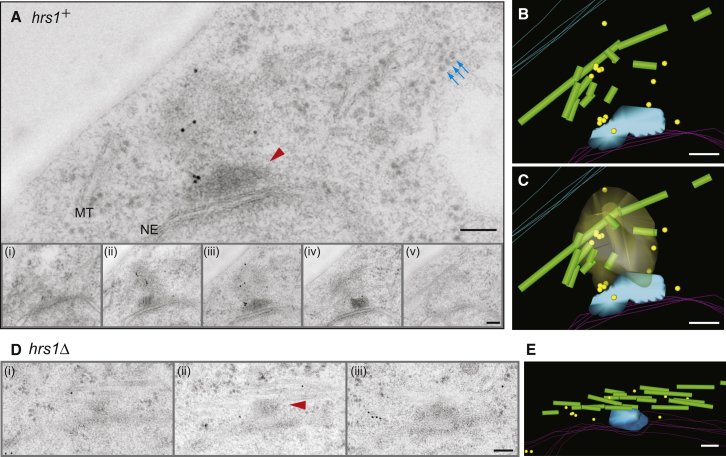
NCBITaxon:4896) · Charlotta Funaya, Shivanthi Samarasinghe, Sabine Pruggnaller, Midori Ohta, Yvonne Connolly, Jan Müller, Hiroshi Murakami, Agnes Grallert, Masayuki Yamamoto, Duncan Smith, et al.; Figure 3, DOI:10.1016/j.cub.2012.02.042; CC BY 3.0, via PubMed Central. Original image unchanged; caption paraphrased. · CC_BY_3_0 · source: PMC PMC3382715.1 fig3 · DOI:10.1016/j.cub.2012.02.042Synonyms: rMTOC; rMT organizing center
Components
| Component | Type | Part of / acts on | Grounding | Genes | Stoichiometry | Essential | Role |
|---|---|---|---|---|---|---|---|
| Hrs1/Mcp6-like meiotic organizing protein | Protein | part of | Reviewed label only (reviewed name; no accession asserted) | mcp6, hrs1, mug3 | ESSENTIAL | Localized constituent required for the recognizable meiotic rMTOC in S. pombe. A structural-scaffold role is supported as a model; a purified molecular bridge and its stoichiometry are not resolved.
| |
| Gamma tubulin | Protein | part of | InterPro:IPR002454 | gtb1, tug1 | UNKNOWN | Gamma-tubulin class enriched in the radial organizing region; local enrichment does not specify a complete ring complex or demonstrate sufficiency for rMTOC assembly.
|
Organism-specific protein examples
Named proteins in which each component's role was established, with the organism the evidence comes from. The component above is the taxon-agnostic family; these are the specific entries behind it.
Hrs1/Mcp6-like meiotic organizing protein
| Accession | Protein | Gene | Organism | Entry |
|---|---|---|---|---|
UniProtKB:Q10336 | Meiotic coiled-coil protein 6 | mcp6 | Schizosaccharomyces pombe 972h- (NCBITaxon:284812) | REVIEWED |
Role and evidence (2 references)Reference-sequence exemplar for the species-level localization experiment; the reference stock is not asserted to be the engineered experimental strain.
| ||||
Gamma tubulin
| Accession | Protein | Gene | Organism | Entry |
|---|---|---|---|---|
UniProtKB:P25295 | Tubulin gamma chain | gtb1 | Schizosaccharomyces pombe 972h- (NCBITaxon:284812) | REVIEWED |
Role and evidence (2 references)Reference-sequence exemplar for the species-level localization experiment; the reference stock is not asserted to be the engineered experimental strain.
| ||||
Canonical examples
NCBITaxon:4896Schizosaccharomyces pombe — Meiotic-prophase ultrastructure in synchronized h-/h- pat1.114/pat1.114 mat-Pc diploids: KT2486 with wild-type hrs1 and KT2919 with hrs1 deletion (supplemental Table S1). Homothallic live-cell transition experiments are separate. No clade prevalence or experimental identity with the UniProt reference stock is inferred. [DOI:10.1016/j.cub.2012.02.042]
Functions
- horsetail-astral microtubule organization
GO:0032118— Organizes the radial microtubule array during S. pombe meiotic prophase by concentrating organizing material near the SPB and spatially arranging predominantly capped microtubule ends.DOI:10.1016/j.cub.2012.02.042Tomography, immunolocalization and hrs1 deletion connect the rMTOC to radial geometry. They do not establish purified nucleation sufficiency or a fixed number of microtubules per center.GO:0032118Native GO label and definition verified on 2026-10-08; the term denotes the biological process, not the center identity.
Mechanism graphs
Hrs1-dependent radial center assembly (ASSEMBLY)
S. pombe meiotic prophase. Hrs1 loss tests assembly dependence and local gamma-tubulin enrichment; constituent localization is distinct from a purified binding or nucleation reaction. The HAA is the output array, not an rMTOC constituent. Nuclear movement additionally requires motor machinery.
| Subject | Predicate | Object | Evidence |
|---|---|---|---|
| Hrs1/Mcp6-like meiotic organizing protein | supports_assembly_of | radial microtubule organizing center |
|
| Hrs1/Mcp6-like meiotic organizing protein | supports_local_enrichment_of | Gamma tubulin |
|
| Gamma tubulin | localizes_to | radial microtubule organizing center |
|
| radial microtubule organizing center | organizes | Radial organization of microtubule minus ends |
|
| Radial organization of microtubule minus ends | organizes | horsetail-astral microtubule array |
|
| horsetail-astral microtubule array | supports | dynein-driven meiotic oscillatory nuclear movement |
|
Discussions
- INTERPRETATION (RESOLVED): Keep the radial center distinct from the SPB and output array. Whole-repository searches included hidden/ignored files and parsed identities across 908 records. Earlier HAA/PAA context is not a separate rMTOC record. Native GO label/alias searches with positive HAA/MTOC controls found no exact rMTOC identity, so a local identifier is minted with GO:0005815 as an is-a parent. The source resolves an amorphous assembly near but distinct from the SPB core. GO:0035974 denotes the whole meiotic SPB and GO:0032117 the output array, neither an equivalent. MULTIPROTEIN_COMPLEX denotes an assembly, not a claim of fixed stoichiometry or membrane enclosure. No SPB, nuclear-envelope or HAA parthood is asserted solely from proximity.
- CURATION_TODO (OPEN): Resolve an exact source-neutral Hrs1/Mcp6 family grounding. The native InterPro combined endpoint for Q10336 returned HTTP204, and UniProt did not provide an integrated InterPro family. The SUPFAM Tropomyosin match and the paper's tentative NudE similarity do not define the narrow Hrs1/Mcp6-like organizing class. No unverified family accession or universal cross-species equivalence is asserted.
- INTERPRETATION (RESOLVED): Do not turn neighboring proteins and interaction leads into a complete inventory. The initial inventory covers directly localized Hrs1 and gamma-tubulin classes. Kms1/Kms2 are membrane/SPB interaction context; Alp4 and Mto1 interactions are leads for broader nucleation machinery. Neither yeast-two-hybrid interaction nor an older whole-SPB annotation establishes every partner as a localized constituent of the 2012-defined amorphous region. These proteins are not imported here as a complete ring, and their omission is a bounded curation decision, not a claim of absence. Alpha/beta polymers are the associated output array, not automatically the center matrix.
- KNOWLEDGE_GAP (OPEN): Resolve the native molecular bridge, complete composition and nucleation mechanism. Hrs1 localization and deletion establish membership and assembly dependence, but the detailed scaffold/bridge geometry is proposed. Gamma-tubulin enrichment does not establish a purified nucleation reaction, fixed ring stoichiometry or the necessity of gamma tubulin for forming the amorphous matrix. Dynein-assisted rearrangement includes unpublished observations, and the paper explicitly leaves conversion from interphase arrays unresolved. No distances or counts from selected tomograms are promoted to universal center dimensions.
- INTERPRETATION (RESOLVED): Retain the experimental limits of rMTOC downregulation. Hrs1 degradation and phosphorylation jointly downregulate the organizing system near meiosis I. Stabilized nonphosphorylatable Hrs1 delays bipolar spindle formation under specified temperature/checkpoint conditions; it does not universally block separation. Individual phosphosite functions and the responsible kinases/E3 enzymes remain unresolved. Proposed holding of duplicated SPBs is not a purified mechanical measurement. Vegetative overexpression aggregates and HAA-like output are not automatically normal meiotic rMTOCs, and phosphorylation is not proof of destruction of every constituent.
- INTERPRETATION (RESOLVED): Keep specimen, imaging and source-access scope explicit. Only S. pombe is a canonical organism exemplar, with no inferred clade frequency. Reference proteins from taxon284812 are not asserted to be the engineered KT2486/KT2919 experimental stocks. EM used high-pressure freezing, freeze substitution and resin sections, not vitreous cryo-ET. Main immuno-EM text/captions specify 80 minutes whereas supplemental immunolabeling methods specify 120 minutes; no single universal sampling time is assigned. Figure 3 includes TEM sections and interpretive 3D models, and contrasts wild-type hrs1 with deletion. The original image is unchanged CC BY 3.0 material; 100 nm bars are image provenance, not a curated whole-center dimension. Main text, captions and supplemental pages13-22 were read, but movies, raw data and most supplemental panels were not inspected.
Evidence
DOI:10.1016/j.cub.2012.02.042PMID22425159; complete main text and captions read through native PMC3382715.1 JATS, plus supplemental Table S1 and methods on PDF pages13-22. Selected supplemental pages and the unchanged Figure 3 were visually inspected. Movies and raw data were not inspected.GO:0005815Verified broader MTOC class, not an exact identity. Explicit SQL-wildcard GO label/alias searches found no exact rMTOC term; HAA and MTOC positive controls returned expected results.
Curation history
2026-10-08T06:33:22Zcodex · CREATED_RECORD — Scaffolded by scripts/new_record.py2026-10-08T06:35:59Zcodex · EXPANDED_RECORD — Added two source-bounded component classes with verified reference proteins, one function and six-edge assembly graph, six boundary/gap discussions and an unchanged checksum-verified CC BY 3.0 figure; retained PROPOSED status.
Source: data/structures/cytoskeleton/radial_microtubule_organizing_center.yaml