basal body cartwheel inner density
A morphologically distinct subassembly within the lumen of a microbial basal-body cartwheel hub, observed as a central electron-dense unit separate from the surrounding hub rings and radial spokes. Such units can repeat along the cartwheel axis, with nonuniform occupancy. [DOI:10.15252/embj.2020106246]
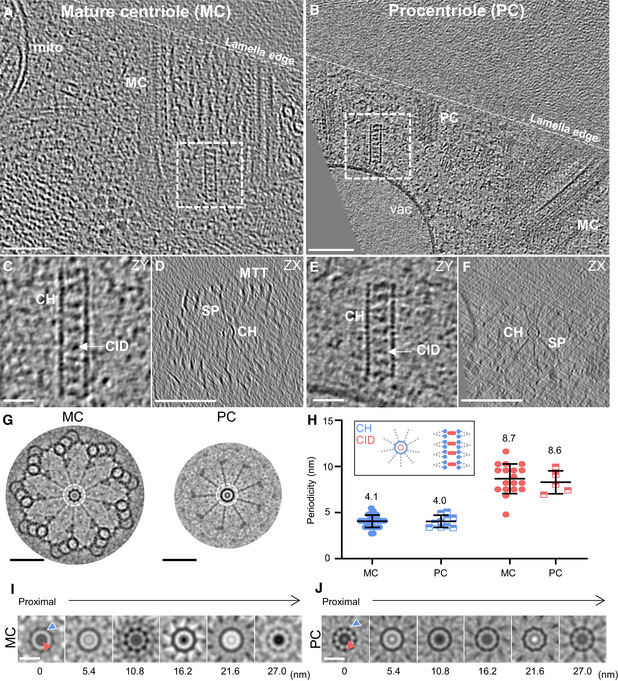
NCBITaxon:3055) · Nikolai Klena, Maeva Le Guennec, Anne‐Marie Tassin, Hugo van den Hoek, Philipp S Erdmann, Miroslava Schaffer, Stefan Geimer, Gabriel Aeschlimann, Lubomir Kovacik, Yashar Sadian, et al.; CC BY, via PubMed Central · CC_BY_4_0 · source: PMC PMC7667884.1 embj2020106246-fig-0001 · DOI:10.15252/embj.2020106246Synonyms: cartwheel inner density; CID; centriole cartwheel inner density
Part of: basal body cartwheel (cellstructuremech:basal_body_cartwheel)
Canonical examples
NCBITaxon:3055Chlamydomonas reinhardtii — In-situ cryo-FIB/cryo-ET of mat3-4 cells resolves CIDs within the hubs of mature basal bodies and pro-basal bodies. Figure 1 distinguishes the inner densities from the surrounding hub. The Results paragraph discussing the Figure 3 reconstruction also reports raw regions without CID, citing Appendix Figure S4D. [DOI:10.15252/embj.2020106246]NCBITaxon:5888Paramecium tetraurelia — Cryo-ET of isolated cortical units and cartwheel averaging resolve CIDs in Figures 2 and 3. Preparation used d4-2 and Delta-CenBP1 strains; the cited figure is not assigned to one strain. These are native specimens, not recombinant SAS-6 rings. [DOI:10.15252/embj.2020106246]NCBITaxon:5762Naegleria gruberi — Basal bodies isolated from NEG cells differentiated into flagellates show CIDs in Figure 2 and Figure EV2. Periodicities were assessed in undamaged regions because preparation often compressed the basal bodies. This does not assert CID presence in the amoeboid stage. [DOI:10.15252/embj.2020106246]NCBITaxon:63628Trichonympha agilis — Purified basal bodies from flagellates extracted from Reticulitermes speratus hindguts were examined by cryo-ET and subtomogram averaging. Figure 2F-J and Figure EV1 describe 55% and 45% subvolume classes that can occur within one basal body, not separate taxa or population prevalence estimates. [DOI:10.15252/embj.2020106249]
Physical properties
- OTHER: 8.7 +/- 1.6
UO:0000018(Axial spacing between CIDs in mature Chlamydomonas reinhardtii basal bodies imaged in situ in mat3-4 cells; Klena Figure 1, plotted in panel H of the original graphic. Mean and SD, n=18 measured distances, not 18 cells or protein copies. This is not CID diameter, hub-ring spacing, or a universal repeat.) [DOI:10.15252/embj.2020106246] - OTHER: 8.6 +/- 1.2
UO:0000018(Axial CID spacing in Chlamydomonas reinhardtii pro-basal bodies in the same in-situ mat3-4 study; Klena Figure 1. Mean and SD, n=5 measured distances. Mature and pro-basal-body measurements are separate observations, not a time course or a demonstrated developmental change.) [DOI:10.15252/embj.2020106246] - OTHER: 8.3 +/- 0.5
UO:0000018(Axial spacing between CID elements in the Trichonympha agilis 55% central-cartwheel subvolume class, Nazarov Figure 2H. Reported mean and error; the caption does not name the error statistic. N=9 denotes 2D measurements from the subtomogram average, not independent cells. The 55% is a reconstruction-class fraction, not biological occupancy.) [DOI:10.15252/embj.2020106249] - OTHER: 15.2
UO:0000018(Distance between two CID elements in the Trichonympha agilis 45% central-cartwheel class, Nazarov Figure EV1C; N=1 2D measurement from the subtomogram average, with no error estimate. An intervening single hub unit lacks a neighboring CID. This is not a species-wide mean or a second universal repeat.) [DOI:10.15252/embj.2020106249]
Discussions
- CURATION_TODO (RESOLVED): Keep the named inner-density subassembly distinct from the cartwheel hub and its proteins. A density-defined cellular subassembly is not a protein assignment, and the CID abbreviation has been used at two levels of granularity.
- CURATION_TODO (OPEN): Identify native microbial CID constituents and test CID-specific biological roles. Morphological contacts and structural models do not demonstrate a protein identity, necessity, or causal mechanism.
- CURATION_TODO (RESOLVED): Do not transfer SAS-6 hub assignments or speculative fly Poc1B assignments into microbial CID composition. A surrounding hub protein and a proposed analogous host structure do not identify this microbial subassembly.
- CURATION_TODO (OPEN): Resolve whether discrete CID and filamentous CID share molecular identity or homology. A similar location does not establish equivalence of discontinuous central units and a continuous axial filament.
- CURATION_TODO (OPEN): Reconcile class- and reference-frame-specific CID polarity without imposing universal occupancy. Different sample preparations, resolution limits and geometric reference axes can produce distinct observations.
- CURATION_TODO (OPEN): Inspect the full 2026 Trichonympha study before extending molecular or mechanistic claims. An abstract and deposited hub model cannot substitute for Results and Methods or identify an unmodeled density.
- CURATION_TODO (RESOLVED): Keep CID spacing, hub architecture, reconstruction processing and taxonomic scope separate. Image labels, symmetry processing and measurement counts are not interchangeable with molecular or population evidence.
Datasets
- Trichonympha agilis central cartwheel without variations, 55% class (
EMDB:EMD-10916) · OTHER · STRUCTURAL_IMAGING
Organism: Trichonympha agilis · Platform: cryo-electron tomography and subtomogram averagingNative metadata verifies released status, the 55% title, taxon 63628, DOI and PMID:32954505. Metadata and links only; no map volume downloaded and no exact CID xref asserted.
- Trichonympha agilis central cartwheel with variations, 45% class (
EMDB:EMD-10918) · OTHER · STRUCTURAL_IMAGING
Organism: Trichonympha agilis · Platform: cryo-electron tomography and subtomogram averagingNative metadata verifies released status, the 45% title, taxon 63628, DOI and PMID:32954505. No map volume downloaded or exact structure xref asserted. Percentages describe classified subvolumes, not fractions of organisms.
Evidence
DOI:10.15252/embj.2020106246Klena et al. 2020, PMID:32954513. Checksum-verified PMC7667884.1 Introduction, CID Results, figure captions, Discussion and specimen/averaging Methods inspected. Original Figure 1 visually inspected. Supports named inner-density identity and native microbial examples, not molecular composition or a proven CID-specific mechanism.DOI:10.15252/embj.2020106249Nazarov et al. 2020, PMID:32954505. Checksum-verified PMC7667878.1 Results, Figure 2 and Figure EV1 captions, Discussion and specimen preparation inspected. Distinguishes the discrete CID, variable cartwheel classes, and the potentially related filamentous form; proposed symmetry and polarity roles are not treated as experimental functions.
Curation history
2026-10-04T16:37:12Zcodex · CREATED_RECORD — Scaffolded by scripts/new_record.py2026-10-04T16:39:15Zcodex · CURATED_RECORD — Added four native microbial CID examples, scoped axial spacings, distinct reconstruction classes and an inspected unmodified CC BY figure. Defined whole-CID granularity and cartwheel parthood; preserved uncertain composition, functions, polarity and filamentous-form homology. Declined unsupported hub-protein and speculative host Poc1B assignments and documented the unread newer full-text boundary.2026-10-04T16:40:25Zcodex · CURATED_RECORD — Refined the Chlamydomonas occupancy source pointer to the inspected Results paragraph and its Appendix Figure S4D citation.
Source: data/structures/cytoskeleton/basal_body_cartwheel_inner_density.yaml