basal body filamentous cartwheel inner density
An apparently continuous filamentous subassembly extending longitudinally within the lumen of a microbial basal-body cartwheel hub. It is morphologically distinguishable from the surrounding hub rings and spokes and from discontinuous cartwheel inner-density units. [DOI:10.15252/embj.2020106249]
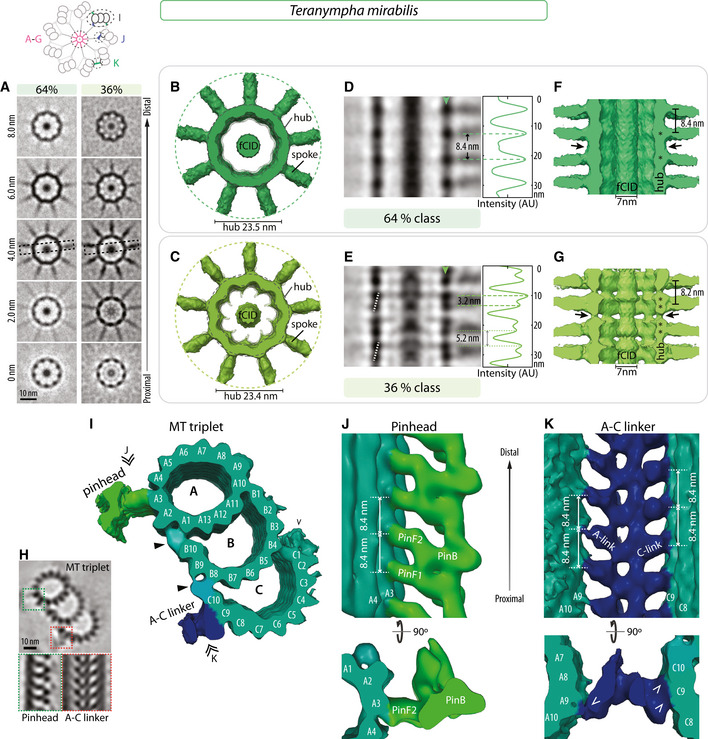
NCBITaxon:285686) · Sergey Nazarov, Alexandra Bezler, Georgios N Hatzopoulos, Veronika Nemčíková Villímová, Davide Demurtas, Maeva Le Guennec, Paul Guichard, Pierre Gönczy; CC BY, via PubMed Central · CC_BY_4_0 · source: PMC PMC7667878.1 embj2020106249-fig-0004 · DOI:10.15252/embj.2020106249Synonyms: filamentous cartwheel inner density; filamentous CID; fCID
Part of: basal body cartwheel (cellstructuremech:basal_body_cartwheel)
Canonical examples
NCBITaxon:285686Teranympha mirabilis — Native basal bodies from hindgut flagellates of Reticulitermes speratus were examined by cryo-ET and subtomogram averaging. Preparation began with mixed Trichonympha agilis and Teranympha mirabilis cells, with a sedimentation step enriching the latter. Whole-cell morphology distinguished resin-embedded species; purified cryo-ET basal bodies were assigned using fCID presence or absence. This retains the source's morphology-based attribution, not an independent molecular identification. Figure 4 resolves fCID in both 64% and 36% cartwheel subvolume classes, which can coexist within one basal body. [DOI:10.15252/embj.2020106249]
Physical properties
- DIAMETER: approximately 7
UO:0000018(Approximate diameter of the filamentous cartwheel inner density in purified Teranympha mirabilis basal bodies, Figure 4F-G and the corresponding Results. The value is reported for both 64% and 36% central-cartwheel reconstruction classes. No sample count or error statistic is supplied for this diameter. It is not the approximately 23-nm hub diameter, an axial hub/spoke spacing, or a measurement of discrete CID.) [DOI:10.15252/embj.2020106249]
Discussions
- CURATION_TODO (RESOLVED): Keep the continuous inner filament distinct from the cartwheel hub and discrete CID. A named morphological subassembly is not a single protein or an entire cartwheel.
- CURATION_TODO (OPEN): Identify native fCID constituents and test filament-specific biological roles. Morphology and proximity do not identify molecules or demonstrate necessity.
- CURATION_TODO (RESOLVED): Do not transfer SAS-6 hub-ring fitting to the luminal filament. The filament and the protein-containing hub are separate structures in the source maps.
- CURATION_TODO (OPEN): Resolve the molecular relationship to discrete CID and the filament's connections and helicity. Similar position and appearance do not establish homology, molecular equivalence or dynamics.
- CURATION_TODO (RESOLVED): Preserve morphology-based specimen attribution and reconstruction processing boundaries. Classified subvolumes and imposed symmetry are not independent organisms or molecular evidence.
- CURATION_TODO (OPEN): Reconcile the free-text sample names in EMD-10922 and EMD-10923 with their structured taxonomy. A mismatched sample name must not silently create a different organism assertion.
- CURATION_TODO (RESOLVED): Keep filament dimensions separate from surrounding hub and spoke measurements. The same multipanel figure contains several structures with different measured quantities.
Datasets
- Teranympha mirabilis central cartwheel without variations, 64% class (
EMDB:EMD-10922) · OTHER · STRUCTURAL_IMAGING
Organism: Teranympha mirabilis · Platform: cryo-electron tomography and subtomogram averagingNative metadata verifies released status, the class title, natural-source organism Teranympha mirabilis with taxon 285686, and DOI/PMID:32954505. The sample and supramolecule free-text names instead say Teranympha agilis; this discrepancy is retained, not adopted as the organism identity. The paper and structured organism field support the curated taxon. Percentages are classified subvolumes, not species prevalence. Metadata and links only; no map volume downloaded or exact fCID xref asserted.
- Teranympha mirabilis central cartwheel with variations, 36% class (
EMDB:EMD-10923) · OTHER · STRUCTURAL_IMAGING
Organism: Teranympha mirabilis · Platform: cryo-electron tomography and subtomogram averagingNative metadata verifies released status, the class title, natural-source organism Teranympha mirabilis with taxon 285686, and DOI/PMID:32954505. The sample and supramolecule free-text names instead say Teranympha agilis; this discrepancy is retained, not adopted as the organism identity. The paper and structured organism field support the curated taxon. Percentages are classified subvolumes, not species prevalence. Metadata and links only; no map volume downloaded or exact fCID xref asserted.
Evidence
DOI:10.15252/embj.2020106249Nazarov et al. 2020, PMID:32954505. Checksum-verified PMC7667878.1 dedicated Teranympha Results, conserved-architecture Discussion, Figure 4 and EV3 captions, specimen preparation, cryo-ET acquisition and subtomogram processing Methods inspected. Original Figure 4 visually inspected. Supports a named continuous inner filament, not its molecular composition or proven function.
Curation history
2026-10-04T17:21:33Zcodex · CREATED_RECORD — Scaffolded by scripts/new_record.py2026-10-04T17:23:20Zcodex · CURATED_RECORD — Added native morphology-defined fCID identity, scoped Teranympha specimen and approximate diameter, distinct EMDB classes and an inspected unmodified CC BY figure. Preserved specimen-assignment and deposition-name caveats, reconstruction processing, and unresolved composition, function and CID homology.
Source: data/structures/cytoskeleton/basal_body_filamentous_cartwheel_inner_density.yaml