quiescent nuclear microtubule bundle
A stable monopolar bundle of parallel nuclear microtubules formed during glucose-exhaustion-induced quiescence, characterized in Saccharomyces cerevisiae. The bundle extends from the nuclear face of the spindle pole body and reorganizes kinetochore and centromere distribution; it is distinct from the antiparallel cytoplasmic quiescent-cell bundle of fission yeast. [DOI:10.1083/jcb.201306075]
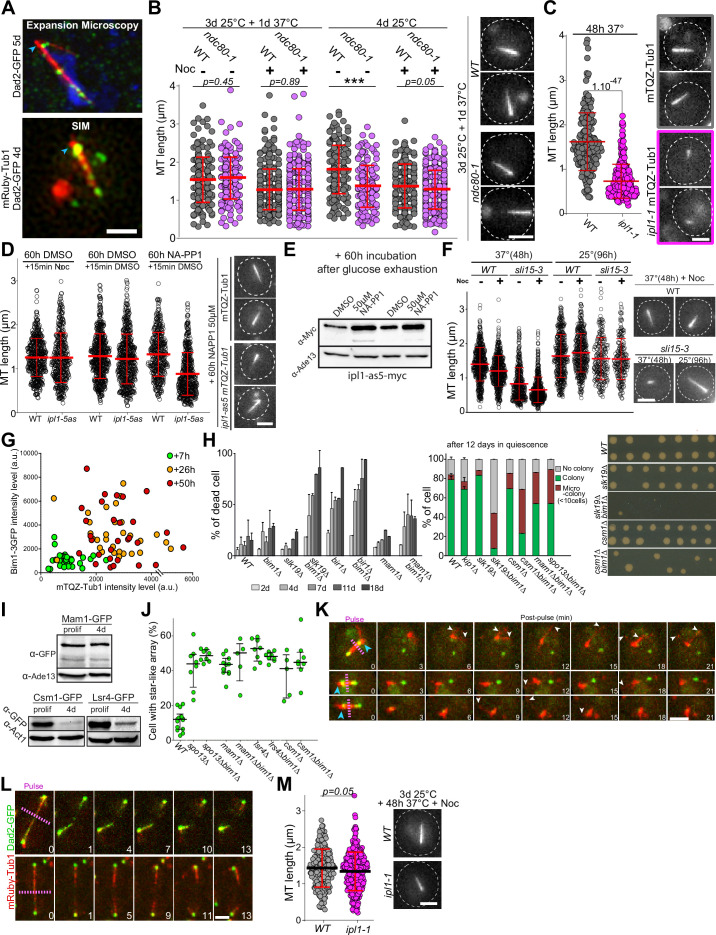
NCBITaxon:4932) · Damien Laporte, Aurelie Massoni-Laporte, Charles Lefranc, Jim Dompierre, David Mauboules, Emmanuel T Nsamba, Anne Royou, Lihi Gal, Maya Schuldiner, Mohan L Gupta, et al.; CC BY, via PubMed Central · CC_BY_4_0 · source: PMC PMC10963028.1 fig3s1 · DOI:10.7554/eLife.89958Synonyms: Q-nMT bundle; quiescent-cell nuclear microtubule bundle
Part of: nucleus (GO:0005634); GO:0015630 — microtubule cytoskeleton (no local record)
Has part: nuclear microtubule (GO:0005880)
Components
| Component | Type | Part of / acts on | Grounding | Genes | Stoichiometry | Essential | Role |
|---|---|---|---|---|---|---|---|
| Alpha tubulin | Protein | part of | InterPro:IPR002452 | TUB1, TUB3 | UNKNOWN | Alpha-tubulin subunits of the nuclear bundle; Tub1 and Tub3 colocalize, with distinct contributions to assembly.
| |
| Beta tubulin | Protein | part of | InterPro:IPR002453 | UNKNOWN | Beta partner class of the alpha/beta microtubule polymer; no beta-isotype localization assay is inferred.
| ||
| XMAP215 | Protein | part of | InterPro:IPR045110 | STU2 | UNKNOWN | Microtubule-associated regulator localized at both bundle ends and occasional intermediate puncta.
| |
| Bik1-like CLIP-170 microtubule-associated protein | Protein | part of | Reviewed label only (reviewed name; no accession asserted) | BIK1 | UNKNOWN | Resident microtubule-associated protein detected at both ends of the quiescent array.
| |
| Microtubule-associated protein RP/EB | Protein | part of | InterPro:IPR027328 | BIM1 | DISPENSABLE | Bundle-associated EB protein; single BIM1 deletion permits stable bundles, with conditional defects when other factors are removed.
| |
| Kar3-like kinesin-14 motor | Protein | part of | Reviewed label only (reviewed name; no accession asserted) | KAR3 | UNKNOWN | Resident motor contributing to early normal bundle assembly; motor-driven crosslinking is not directly resolved.
| |
| Kinesin-like protein KIF11-like | Protein | part of | InterPro:IPR047149 | CIN8, KIP1 | UNKNOWN | Resident kinesin-5 class with distinct activities: Cin8 affects phase-II bundle thickness, whereas Kip1 supports full stabilization.
| |
| Bir1-like chromosomal passenger protein | Protein | part of | Reviewed label only (reviewed name; no accession asserted) | BIR1 | UNKNOWN | Resident chromosomal passenger protein distributed along the bundle and enriched at its distal end.
| |
| Sli15-like inner centromere protein | Protein | part of | Reviewed label only (reviewed name; no accession asserted) | SLI15 | UNKNOWN | Resident INCENP-like passenger protein associated with assembly and stabilization of the bundle.
| |
| Slk19-like microtubule-associated protein | Protein | part of | Reviewed label only (reviewed name; no accession asserted) | SLK19 | UNKNOWN | Resident bundle-end protein contributing to mature bundle dimensions and stability.
|
Organism-specific protein examples
Named proteins in which each component's role was established, with the organism the evidence comes from. The component above is the taxon-agnostic family; these are the specific entries behind it.
Alpha tubulin
| Accession | Protein | Gene | Organism | Entry |
|---|---|---|---|---|
UniProtKB:P09733 | Tubulin alpha-1 chain | TUB1 | Saccharomyces cerevisiae S288C (NCBITaxon:559292) | REVIEWED |
Role and evidence (2 references)Reference-sequence exemplar; the accession does not assert that the exact reference stock was imaged.
| ||||
UniProtKB:P09734 | Tubulin alpha-3 chain | TUB3 | Saccharomyces cerevisiae S288C (NCBITaxon:559292) | REVIEWED |
Role and evidence (2 references)Reference-sequence exemplar; the accession does not assert that the exact reference stock was imaged.
| ||||
XMAP215
| Accession | Protein | Gene | Organism | Entry |
|---|---|---|---|---|
UniProtKB:P46675 | Protein STU2 | STU2 | Saccharomyces cerevisiae S288C (NCBITaxon:559292) | REVIEWED |
Role and evidence (2 references)Reference-sequence exemplar; the accession does not assert that the exact reference stock was imaged.
| ||||
Bik1-like CLIP-170 microtubule-associated protein
| Accession | Protein | Gene | Organism | Entry |
|---|---|---|---|---|
UniProtKB:P11709 | Nuclear fusion protein BIK1 | BIK1 | Saccharomyces cerevisiae S288C (NCBITaxon:559292) | REVIEWED |
Role and evidence (2 references)Reference-sequence exemplar; the accession does not assert that the exact reference stock was imaged.
| ||||
Microtubule-associated protein RP/EB
| Accession | Protein | Gene | Organism | Entry |
|---|---|---|---|---|
UniProtKB:P40013 | Protein BIM1 | BIM1 | Saccharomyces cerevisiae S288C (NCBITaxon:559292) | REVIEWED |
Role and evidence (2 references)Reference-sequence exemplar; the accession does not assert that the exact reference stock was imaged.
| ||||
Kar3-like kinesin-14 motor
| Accession | Protein | Gene | Organism | Entry |
|---|---|---|---|---|
UniProtKB:P17119 | Kinesin-like protein KAR3 | KAR3 | Saccharomyces cerevisiae S288C (NCBITaxon:559292) | REVIEWED |
Role and evidence (2 references)Reference-sequence exemplar; the accession does not assert that the exact reference stock was imaged.
| ||||
Kinesin-like protein KIF11-like
| Accession | Protein | Gene | Organism | Entry |
|---|---|---|---|---|
UniProtKB:P27895 | Kinesin-like protein CIN8 | CIN8 | Saccharomyces cerevisiae S288C (NCBITaxon:559292) | REVIEWED |
Role and evidence (2 references)Reference-sequence exemplar; the accession does not assert that the exact reference stock was imaged.
| ||||
UniProtKB:P28742 | Kinesin-like protein KIP1 | KIP1 | Saccharomyces cerevisiae S288C (NCBITaxon:559292) | REVIEWED |
Role and evidence (2 references)Reference-sequence exemplar; the accession does not assert that the exact reference stock was imaged.
| ||||
Bir1-like chromosomal passenger protein
| Accession | Protein | Gene | Organism | Entry |
|---|---|---|---|---|
UniProtKB:P47134 | Chromosomal passenger complex protein BIR1 | BIR1 | Saccharomyces cerevisiae S288C (NCBITaxon:559292) | REVIEWED |
Role and evidence (2 references)Reference-sequence exemplar; the accession does not assert that the exact reference stock was imaged.
| ||||
Sli15-like inner centromere protein
| Accession | Protein | Gene | Organism | Entry |
|---|---|---|---|---|
UniProtKB:P38283 | Inner centromere protein SLI15 | SLI15 | Saccharomyces cerevisiae S288C (NCBITaxon:559292) | REVIEWED |
Role and evidence (2 references)Reference-sequence exemplar; the accession does not assert that the exact reference stock was imaged.
| ||||
Slk19-like microtubule-associated protein
| Accession | Protein | Gene | Organism | Entry |
|---|---|---|---|---|
UniProtKB:Q08581 | Kinetochore protein SLK19 | SLK19 | Saccharomyces cerevisiae S288C (NCBITaxon:559292) | REVIEWED |
Role and evidence (2 references)Reference-sequence exemplar; the accession does not assert that the exact reference stock was imaged.
| ||||
Canonical examples
NCBITaxon:4932Saccharomyces cerevisiae — Budding yeast studied by fluorescence, expansion microscopy, laser ablation and perturbations; the 2013 defining study additionally supplies TEM. Strain backgrounds differ among assays; no all-fungi prevalence is asserted. [DOI:10.7554/eLife.89958]
Functions
- Quiescent nuclear reorganization — The nuclear array supports relocation of kinetochore-centromere clusters away from the SPB and displacement of the nucleolus.
DOI:10.1083/jcb.201306075Kinetochore and centromere localization, plus no-array mutants, associate array formation with nuclear reorganization; chromosomes and nucleolus are not treated as bundle constituents.
- Support of quiescent survival and recovery — Bundle formation contributes to survival and subsequent colony formation in the tested glucose-exhaustion conditions.
DOI:10.1083/jcb.201306075Array-defective mutants lose viability and regrowth capacity; pleiotropic effects limit a uniquely bundle-specific causal claim.DOI:10.7554/eLife.89958Early nocodazole prevents formation and impairs survival/regrowth, whereas late treatment of stabilized bundles does not have the same effect. This narrows but does not eliminate off-target explanations.
Mechanism graphs
Glucose exhaustion and early bundle assembly (ASSEMBLY)
Physiological and perturbation-defined mechanism in S. cerevisiae; the upstream glucose-exhaustion signal and exact crosslinking reactions are unresolved.
| Subject | Predicate | Object | Evidence |
|---|---|---|---|
| Glucose exhaustion | stimulates | Q-nMT bundle assembly |
|
| Functional kinetochore-microtubule attachment | supports | Q-nMT bundle assembly |
|
Regulated disassembly on quiescence exit (DISASSEMBLY)
Exit from glucose-exhaustion-induced quiescence; timing and deletion evidence do not identify a molecular checkpoint. Kip3 and She1 are external regulators, not inferred stable residents.
| Subject | Predicate | Object | Evidence |
|---|---|---|---|
| Glucose refeeding | stimulates | Q-nMT bundle disassembly |
|
| Kinesin-like protein KIP3 | supports | Q-nMT bundle disassembly |
|
| Mitotic spindle-associated protein SHE1 | supports | Q-nMT bundle disassembly |
|
| Q-nMT bundle disassembly | supports | Spindle pole body separation |
|
Discussions
- CURATION_TODO (RESOLVED): Keep the nuclear Q-nMT identity separate from generic nuclear microtubules and cytoplasmic Q-MT. Hidden- and ignored-inclusive identity, synonym and citation searches, plus a parsed identity scan, found no existing record. OAK GO alias searches and native GO definitions do not supply an exact Q-nMT term. GO:0099070 is broader; GO:0005880 is a constituent filament. The parallel monopolar nuclear array is not the antiparallel cytoplasmic S. pombe bundle or a bipolar mitotic spindle. OTHER denotes the whole array. Bare nuclear microtubule array is not adopted as an exact synonym.
- CURATION_TODO (OPEN): Find exact whole-protein families for five label-only resident classes. Complete native InterPro matches were read for Bik1 P11709, Kar3 P17119, Bir1 P47134, Sli15 P38283 and Slk19 Q08581. Broad kinesin/BIR families and CAP-Gly, ARK-binding or TACC domains do not exactly identify these narrower classes. Label-only grounding is retained pending an exact authority entry.
- CURATION_TODO (RESOLVED): Separate bundle composition from its nucleation site and attached chromosomal assemblies. The SPB nucleates the array but is not its containing structure. Tub4/Spc97/Spc72 mark the nucleation site. All six kinetochore subcomplexes have array-associated localization in 2013; Dad2 and Nuf2 mark attachments in 2024. These are retained as interacting chromosome-bound machinery rather than asserted stoichiometric building blocks of the microtubule bundle. Centromeric Cse4/chromosomes and the displaced nucleolus are likewise not bundle components. Slk19 is included because its own direct bundle-end localization and perturbation are documented.
- CURATION_TODO (RESOLVED): Do not turn genetic requirements or expression into residence. Dynein and dynactin are detected on the cytoplasmic SPB face in 2013, not inside the nuclear array. Cik1 requirement, monopolin Mam1/Lrs4/Hrr25/Csm1 expression and deletion phenotypes, Spo13 effects, and tubulin-folding factors do not alone establish Q-nMT residence. Ipl1 activity is required early, but Ipl1 and Nbl1 were not detected in quiescence; the whole CPC is not imported from Bir1/Sli15 localization. Kip3 and She1 exit phenotypes are modeled as regulatory evidence, not stable-component evidence. She1 P38200 is distinct from the MYO4/SHE1 homonym P32492.
- CURATION_TODO (RESOLVED): Keep assay sensitivity and individual deletion effects explicit. Kar3 was not detected in 2013 but later detected with 3GFP in 2024. Cin8 localization is faint and channel controls are shown in Figure 4 supplement 1B. Single BIM1 deletion permits stable bundles, whereas combinations expose redundancy. Tub3-specific requirements do not make Tub3 irreplaceable because Tub1 substitution restores stable bundles. Cin8 and Kip1 share a family but have distinct phenotypes; family-wide necessity is not tested. Short residual bundles after several deletions preclude an unqualified assembly-essential claim.
- KNOWLEDGE_GAP (OPEN): Resolve stabilization without upgrading models into measured mechanisms. Nocodazole resistance, low tubulin turnover and stability after laser severing bound stability to these assays. A GTP cap inferred from Bim1 binding is not directly measured, and microtubule crosslinking mechanisms remain models. Survival/regrowth effects are supported but perturbations also act beyond this array. Proposed tubulin storage, a molecular SPB-separation checkpoint and homology with primary cilia are not asserted as demonstrated functions.
- CURATION_TODO (RESOLVED): Avoid mixing biological dimensions, experimental expansion and control cells. Bundle length, thickness and maturation timing vary with condition; the 2024 Results and Discussion describe different approximate times for full stabilization. No universal size, count or schedule is imposed. Expansion microscopy expands the specimen, not the living bundle. Hosted Figure 3 supplement 1 is the unmodified mixed-modality figure: A and K include Q-nMT imaging; L is a proliferating-cell anaphase-spindle control. Cytoplasmic yellow background in A is explicitly described as nonspecific in Methods, not GFP localization.
- CURATION_TODO (RESOLVED): Keep taxonomy, dataset coverage and licence claims bounded. Only S. cerevisiae is a canonical species. Most experiments use BY4741/BY4742 backgrounds, with stated S288C and W303 exceptions; reference-sequence examples are not exact-stock assertions. The adopted iModulonDB inventory has 28 datasets and no S. cerevisiae dataset; this is not a search of all omics repositories. Announced source-data spreadsheets were not inspected or promoted to curated datasets. Native PMC10963028.1 JATS and metadata agree on CC BY 4.0; the 2013 CC BY-NC-SA 3.0 figure is not hosted. No unverified TraitMech or Complex Portal link is added.
Evidence
DOI:10.1083/jcb.201306075Laporte et al. (2013), PMID 24247429, native PMC3840927.1 Results, Discussion and relevant Methods: defining nuclear-array morphology, localization, perturbation and exit evidence.DOI:10.7554/eLife.89958Laporte et al. (2024), PMID 38527106, native PMC10963028.1 Results, Discussion and relevant Methods; Figure 3 supplement 1 and Figure 4 supplement 1 visually inspected.GO:0099070Non-obsolete static microtubule bundle term is broader than Q-nMT. Its Q-MT narrow synonyms concern the distinct fission-yeast cytoplasmic bundle.GO:0005634Native nucleus term supports nuclear compartment parthood.GO:0015630— microtubule cytoskeleton Native microtubule cytoskeleton term supports the encompassing framework.GO:0005880Native nuclear microtubule term describes the constituent polymers, not the whole multi-filament array.
Curation history
2026-10-05T16:36:00Zcodex · CREATED_RECORD — Scaffolded by scripts/new_record.py2026-10-05T16:38:33Zcodex · EXPANDED_RECORD — Added ten component classes, eleven native-verified protein examples, bounded assembly/disassembly graphs, an inspected CC BY 4.0 figure, and explicit identity, component-boundary and evidence limitations.2026-10-11T21:55:51Zcodex · ADDRESS_SAVED_REVIEW — Addressed #2260, #2261: exposed preserved discussion explanations and graph scope in supported display fields; corrected Tub3 localization to Figure 2A and Figure 2 supplement 1A.
Source: data/structures/cytoskeleton/quiescent_nuclear_microtubule_bundle.yaml